Key Takeaways
- Buyers can use a diamond grading report to verify its authenticity, quality, and key characteristics, helping them make informed purchasing decisions.
- A trusted independent laboratory provides accurate and unbiased diamond grading reports, helping buyers make confident purchasing decisions.
- Understanding the 4Cs—Cut, Clarity, Colour, and Carat Weight—helps buyers evaluate a diamond’s appearance, quality, and overall value.
- A diamond grading report contains important information, including identification details, grading information, diagrams, measurements, and security features that help verify the stone.
- Laboratories use security features like watermarks, barcodes, holograms, and unique report numbers to help confirm the authenticity of diamond grading reports.
Introduction
Diamond grading reports vouch for the authenticity and characteristics of your diamond. Its importance is immeasurable. Since it is a scientific blueprint, it would be difficult for an untrained eye to read and decipher a grading report. If you’re struggling with the same, don’t worry we’ve got you covered.
We understand that purchasing a diamond can be a daunting process for many. You’ll have to look for the one that soothes your eyes and doesn’t burn a hole in your pocket. Plus, you’ll have to check for its authenticity, get insurance for it, and take its utmost care in the long run.
As we know that apart from being a huge financial investment, diamonds symbolize some significant event in our life that we want to cherish eternally. Won’t you want to be assured that your purchase is of premium quality and worth the price?
If yes, you’re in the right spot!
Read on to discover how you can read a diamond grading report! (Simplified for beginners!)
What is a Diamond Grading Report/ Diamond Certificate?
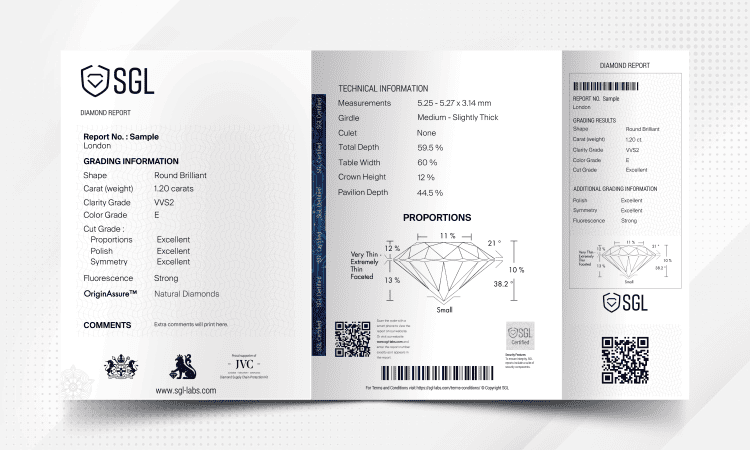
A diamond grading report (more commonly known as “diamond certificates”) is a document disclosing the characteristics of a diamond. It establishes its authenticity and quality based on a scientific procedure used for assessment.
Although being a scientific blueprint, a grading report is not devoid of subjectivity. After all, diamonds are graded by gemologists and the report contains their opinion of the diamond in question.
Also, you might notice that reports from different grading laboratories differ to a great extent. This is because different labs adopt different grading standards. For an unbiased and authentic report, go for an independent and trusted laboratory like SGL.
Importance of Diamond Certificate/ Grading Report
A diamond grading report is not just a mere document, it’s an assurance to the consumer that they’re getting what the jeweller has told them about a particular piece. Moreover, the grading report discloses whether the diamond is natural or lab-grown, treated or untreated, and its 4Cs.
To understand these quality factors in detail, you can explore our guide on the 4Cs of diamonds. It also proves useful during resale and helps in identifying the diamond in case of loss or theft.
What Does a Diamond Grading Report Contain?
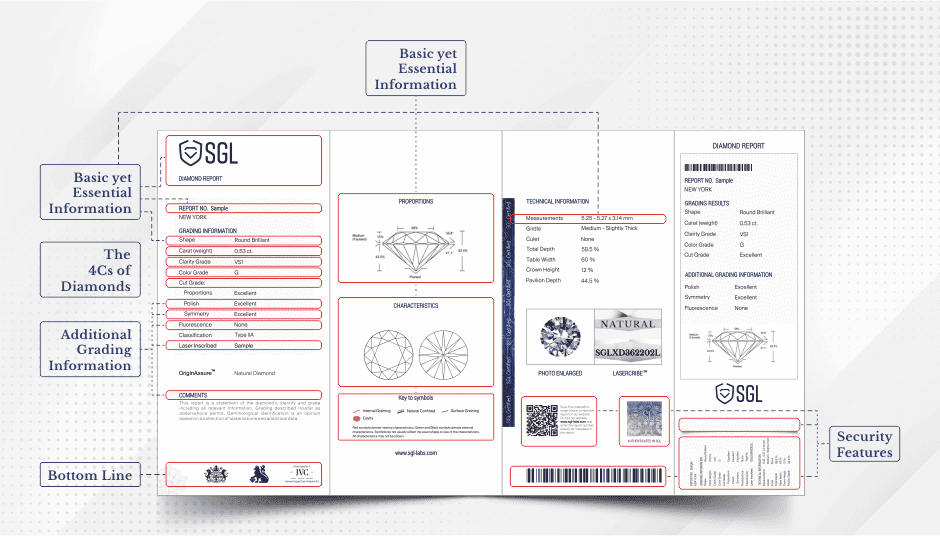
For ease of understanding, we’ve divided the components of the report into 5 parts (as you’ll see later). However, the actual report is not divided into any part.
With that said, let’s move on without any further ado!
Part 1: Basic yet Essential Information
As and when you get a diamond grading report, you must check the following information. These are just the basic information that every diamond report must have.
(Note: The hard copy of the diamond certificate will look slightly different from its digital copy. Nonetheless, the content would be similar. )
- Header
It contains the name of the grading laboratory. For accurate information, always go for certificates issued by trusted and independent laboratories like SGL. There are a lot of biased in-house laboratories that collaborate with jewellers and offer tainted reports of cheap quality diamonds to fool the consumers. Thus, to be safer, always look for a renowned, trusted, and independent lab report.
- Date of Examination: It’s simply the date on which the diamond in question was graded.
- Report Number
This is perhaps one of the most essential points to note. A report number is a unique identification number created and recorded by the grading lab. In case you misplace your report and need a replacement, this number (which is inscribed on the girdle of your diamond) will make the process easier. Further, this number also comes in handy for direct verification of the report on the lab’s website.
- Shape and Cutting Style
Moving down the report, you’ll see the shape and cutting style of the diamond. For instance, the shape would be “round” and the cutting style “brilliant cut”.
To understand different diamond shapes and cutting styles in detail, you can explore our guide on diamond shapes and cuts.
- Measurements
It defines the size of the stone by listing its height, width, and length measured to the nearest hundredth of a millimeter.
Part 2: The 4Cs of Diamonds
Now comes the most important part; the 4Cs of diamonds.
- Carat Weight
The carat weight notes down the weight of the stone. For instance, 1 carat stone would weigh around 200 milligrams.
- Cut Grade
The cut of a diamond is perhaps the most important of all the Cs. Why? Because it tremendously affects the brilliance and sparkle of diamonds. Usually, the cut of diamonds is graded on a scale of Excellent to Poor.
- Clarity Grade
The clarity of the diamond is graded on a scale of Flawless to Included. This is determined by expert gemologists who examine the stone under 10X magnification for imperfections and inclusions.
- Color Grade
It represents the presence of a hue in a diamond. The color of a diamond is graded on a scale of D to Z with D being colorless and Z being light yellow colored. If the intensity of color goes beyond Z, the fancy color grading system is applied to assess such diamonds.
Part 3: Additional Grading Information
The criteria mentioned in this section further influence the stone’s quality and its overall appearance. It will also influence its price in a minor way compared to the 4Cs.
- Polish
The polish of a diamond plays a key role in influencing its reflections and light transmissions. It refers to the smoothness of the surface of the diamond. A well-polished diamond is bound to emit crisp reflection and undistorted light transmission.
- Symmetry
It measures how symmetrical the shape, alignment, and place of the various facets of diamonds are. Excellent is the best grade while Poor is the worst.
- Fluorescence
It notes down the fluorescence of diamonds (that is how well it glows when placed under UV light). Usually, diamonds graded with None or Faint fluorescent are the best. Further, it’s advisable to stay away from diamonds with Medium, Strong, and Very Strong fluorescent as they look milky and hazy in sunlight.
- Inscriptions
It lists the texts, symbols, and logos, of the grading laboratory inscribed on the diamond.
- Comments
All other miscellaneous information about a diamond is listed in this section. For instance, any treatments the stone has undergone.
Part 4: Diagrams
- Clarity Plot Diagram
Clarity plot diagrams are a graphical representation of the diamond consisting of all of its “birthmarks”. For instance, external blemishes are marked with a green color on the diagram while internal inclusions are marked with red.
- Proportional Diagram
The proportional diagram is for people interested in further inspecting the diamond and who go by numbers. It includes important details such as girdle thickness, table %, depth %, crown angles, pavilion angles, and more.
- Key to Symbols
It decodes the symbols drawn on the diagram that indicates crystal, needle, cloud, pinpoint, etc.
Part 5: Security Features
Lastly, to ensure you get an authentic grading report, look for the security features listed below.
- Watermarks
- Barcode
- Security screens
- Microprinting
- Holograms
Conclusion
Diamond grading reports are an essential document that educates the buyers about the stone they’re purchasing. Further, it has a lot of uses at the time of reselling and identifying after a theft. For deciphering the grading report, you must be well-versed with the 4Cs of diamonds as well as the structure of the lab’s report.
SGL Labs is one of the most reputed and independent diamond grading laboratories. It is incessantly working to empower buyers by offering unabridged diamond certificates. Our best-in-class technology and expert gemologists offer unbiased and quality assessments of every stone we undertake.
For lab-grown diamonds as well, having a dedicated lab-grown diamond report ensures accurate grading and complete transparency.
If you’re looking for a trustworthy laboratory, you know where to come!