Key Takeaways
- Diamond prices mostly depend on the 4Cs: cut, colour, clarity, and carat, along with the market demand and supply, which play the biggest role in setting prices.
- The Rappaport Price List is a global benchmark that helps estimate polished diamond prices based on their quality.
- Cut is one of the biggest factors that affect a diamond’s beauty and value.
- Always compare a diamond’s quality, certification, and price before buying.
- Choosing a certified diamond helps you confirm its authenticity and gives you better value for your money.
Introduction
The 4Cs (cut, colour, clarity, carat), and current market demand and supply play a key role in diamond prices. Even at the same carat weight, diamonds can have different prices because each store differs in quality and rarity.
Finding a diamond that matches your budget and style can be challenging. Diamond prices vary, so understanding what drives their value is the best way to know if you are paying a fair price.
Learn how diamond prices are determined, the factors that affect cost, and how to judge its value before making a purchase. We also share helpful tips to simplify your diamond-buying journey, along with answers to the most frequently asked questions about diamond prices.
Before you embark on the journey of diamond buying, as a buyer it is important to know a few things about the same. They are as follows:
- Educate yourself about the 4Cs
- Understand the impact of the 4Cs on the quality and price of the diamond
- Always pay extra heed to the cut of the diamond, as it determines its overall quality
- You may fluctuate the colour and carat a bit based on your budget
- Find a reliable vendor
- Look out for certification
How is the Price of a Diamond Calculated?
Diamond price is calculated by multiplying the diamond’s carat weight by its price per carat. The price per carat depends on the 4Cs, cut, colour, clarity, and carat, along with current market demand.
Since the 1970s, the Rapaport Price List has helped traders estimate this per-carat rate. It shows the estimated value of polished diamonds by their colour, clarity, and size in a table updated every week.
It is important to note that the price per carat of diamonds on this list is in increments of $100.
A simple formula of multiplying the carat weight by the diamond price per carat is used to determine the cost of a diamond.
(referring to the image on price scope.com)
For instance, to calculate the price of 0.96ct H VVS2 round brilliant cut, we must locate the cell on the table and substitute the values. The price given for H VVS2 is 61 ($100s).
Thus,
Cost = Carat weight x diamond price per carat
= 0.96 X 6100
Final Cost = $5,856
Also, note that the final price of a diamond in the market may differ based on the charges imposed by the lab on the final product. However, this is the minimum price that a vendor is expected to charge for 0.96ct of diamond in colour H, Clarity VVS2 and shape brilliant round cut.
Similarly, we can calculate the price of a more than one-carat diamond. For instance, to calculate the price of 1.35 ct of brilliant round cut, G VS2, we simply multiply the values and get the cost. That is, 1.35 x 7700 = $10,395
Diamond Price vs Diamond Value: What’s the Difference
In short, the prices determined by the Rappaport list, although not final, act as a guiding post for traders and buyers to understand the value of diamonds.
Diamond price is the amount you pay a vendor to buy the diamond. Diamond value is the stone’s actual worth based on its 4Cs, certification, and current market demand. This is the value that matters most if you plan to resell, insure, or appraise the diamond.
The two numbers are often different. When you buy a diamond at retail price, it includes the vendor’s markup, so its resale value is usually lower than the price you paid. This is why diamond valuation always starts with an independent grading report, not the receipt.
To value a diamond, an appraiser looks at four things:
- The 4Cs confirmed in a certified grading report
- Current market prices for that quality combination
- The diamond’s shape and how much demand it has
- Any treatments, enhancements, or damage that reduce its value
To find out what your diamond is really worth, start with a certified report from an accredited lab. Without one, any valuation is only an estimate.
6 Factors That Determine Diamond Pricing
Diamond Prices and Carat
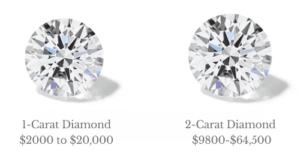
The carat of a diamond plays a key role in determining its price. That said, usually, the higher the carats of diamond, the higher its price. However, the carat alone does not determine the price of a diamond. It is affected by many other factors (which you’ll see in a short while).
1-Carat Diamond Price: 1-carat diamonds are usually bought for wedding or engagement rings. The timeless shape of a round brilliant cut is demanded mostly for wedding rings. The price of a one-carat round brilliant-cut diamond may range from $2000 to $20,000.
2-Carat Diamond price: The average price of a 2-carat round brilliant cut diamond ranges from $9800-$64,500. This sudden jump in price is due to the increase in price per carat.
Cut
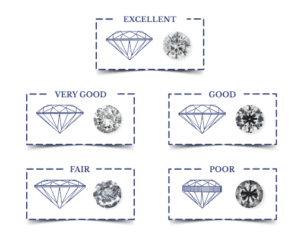
The cut quality is perhaps the most important factor in determining the price of a diamond. A good cut enhances the beauty and optical performance of the diamonds.
Traditionally, diamonds were cut in a way to retain maximum weight while neglecting the spark and the brilliance. However, today, cutters pay extra attention to ensuring a cut that offers the best sparkle even at the cost of its carat.
While choosing a diamond, you may tweak the other factors as per your budget, but, don’t compromise on the cut!
Colour
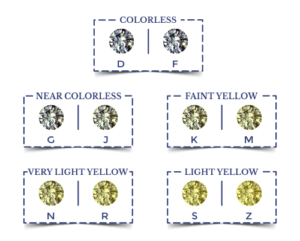
Color refers to the slight hue present in diamonds. The colour-grading scale (refer to the below table) reflects the differences, although very slight, in different diamonds.
The colour differences may be slight but their impact on its price is vast. Thus, colourless diamonds are scarce and command higher prices.
Selecting the right colour depends a lot on your likes and preferences. It is important to select the colour while keeping your budget in mind.
| Colourless | D-F | Extremely rare |
| Nearly Colourless | G-J | Rare |
| Faint | K-M | Rare |
| Very Light | N-R | Widely available |
| Light | S-Z | Plentiful |
Clarity
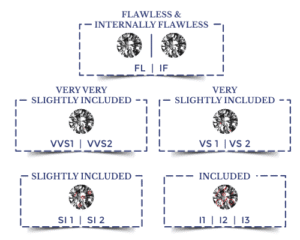
Clarity, too, plays a key role in determining the price of a diamond. For instance, flawless diamonds are rarest in terms of clarity and thus command higher prices. The following table offers a peek into the clarity chart of diamonds:
Flawless Internally Flawless | FL IF | Always Eye Clean |
| Very Very Slightly Included | VVS1 and VVS2 | Characteristics are Minute |
| Very Slightly Included | VS1 and VS2 | Characteristics are Minor |
| Slightly Included | SI1 and SI2 | Characteristics are Noticeable |
| Included | i1, i2 and i3 | Characteristics are Obvious |
As you move from FL and IF to lower clarity grades, you may notice a decreasing trend in price. Usually, VS1 and SI1 are the clarity that allows you to get the best diamond in terms of clarity without burning a hole in your pocket.
Further, for testing the clarity of a diamond,q you may use high-res imaging or a jeweller’s loupe.
Shape
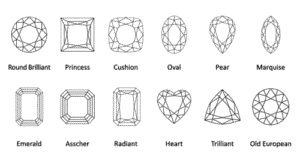
The shape of a diamond refers to the outline of a diamond that we see while glancing at one. For instance, it might be heart shape, round oval, emerald, etc.
The round-shaped diamonds are usually of higher price while princess and oval are more affordable options.
Grading
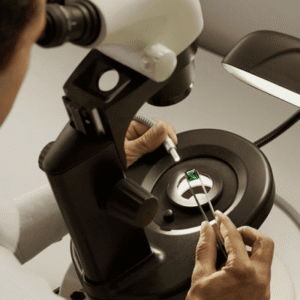
A grading report offers details of a diamond’s attributes, such as its precise cut, clarity, colour, and more. This way, a buyer can be better aware of what they’re paying for.
A grading report may add a bit of strain to your budget, but given the pros, it’s better to invest in the same. SGL’s diamond certificate is widely considered as a mark of reliability in the industry.
Other Market Factors
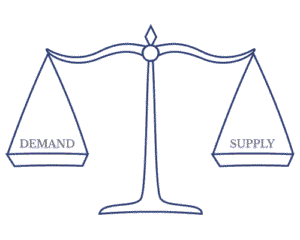
Just like every other factor in a free market economy, the prices of diamonds depend a great deal on the forces of demand and supply. How? Let’s see!
Supply:
- Real diamonds, that is to say, which are naturally formed in the crust of the Earth are scarcely available. Even their presence is not concentrated. As a result, a lot of pressure is put on mines to increase the supply.
- Global events can affect diamond supply and market conditions. Mine closures, trade restrictions, and changes in production in major diamond-producing regions can reduce supply and increase diamond prices. When supply falls, miners and traders often release fewer diamonds to the market, making them scarcer and helping keep prices high.
- Another possibility is that supply may be intentionally restricted by the miners especially when the prices are low.
Demand:
- The state of the global economy plays a key role in determining the demand for diamonds. Undoubtedly, diamonds are coveted by people across the globe. The demand for diamonds in major economies like the US, China and India have a great impact on the overall demand for the same.
- Also, we are aware that demand is determined by the tastes and preferences of people. In the last century or so, diamonds were demanded by kings, queens and other social elites. Today, however, it has changed, That is not to say that people no more demand diamonds. But, people’s preferences have been shifting towards international travel and other luxuries.
- The demand for the diamond depends on advertising. There’s no denying that things that are seen are sold. That’s why major mining companies today are investing heavily in the advertisement of their diamonds.
3 Important Tips for Diamond Buying Success
Although diamond buying may seem an overwhelming task, it is important to pay attention to the key factors that can lead to success in diamond buying. Here are three simple tips that can help you get the best diamond for the price.
- Price Chart: Best diamond vendors usually offer a price chart. This can help you in doing your homework and determining which diamond suits your likes and your pocket! Further, an updated Rappaport list can also help you in being aware of the market prices of diamonds and help you in making a sound decision.
- Quality: The 4Cs of diamond have a major impact on not only its price but also its quality. Thus, understanding them properly before making a purchase is important. Usually, the vendors offer in-depth guides exploring the 4Cs of diamonds to educate their potential buyers and aid in decision-making.
- Certification: Certification from a reliable source ensures the authenticity of diamonds. It acts as an added boon. So, make sure to get certified diamonds from trusted sources.
Conclusion
To calculate a diamond’s price, multiply its carat weight by the price per carat. However, the price per carat depends on the 4Cs, the diamond’s shape, and whether the diamond falls just below or above a key carat threshold. When you compare a natural diamond with a lab-grown diamond or with similar-looking diamonds at different prices, certified quality usually explains the difference.
An independent grading report gives you protection throughout the diamond’s journey, from purchase and insurance to resale. It also helps you verify that the diamond you are buying matches the price you are paying.